16 iýun 2026 ý.
The geological structure of the Çeleken oil field consists of deposits of the red-bed series, Akchagylian, Apsheronian and post-Pliocene periods. The deposits mainly include alternating clay, sandy and siltstone rocks. The area consists of the Western Aligul, Dagajyk and Eastern sections.
Oil deposits are mainly located in the red-bed deposit complex; 11 productive formations have been analyzed in the section. The boundaries of hydrocarbon compounds increase with depth, and the productive formations are located on the northern flank of the area.
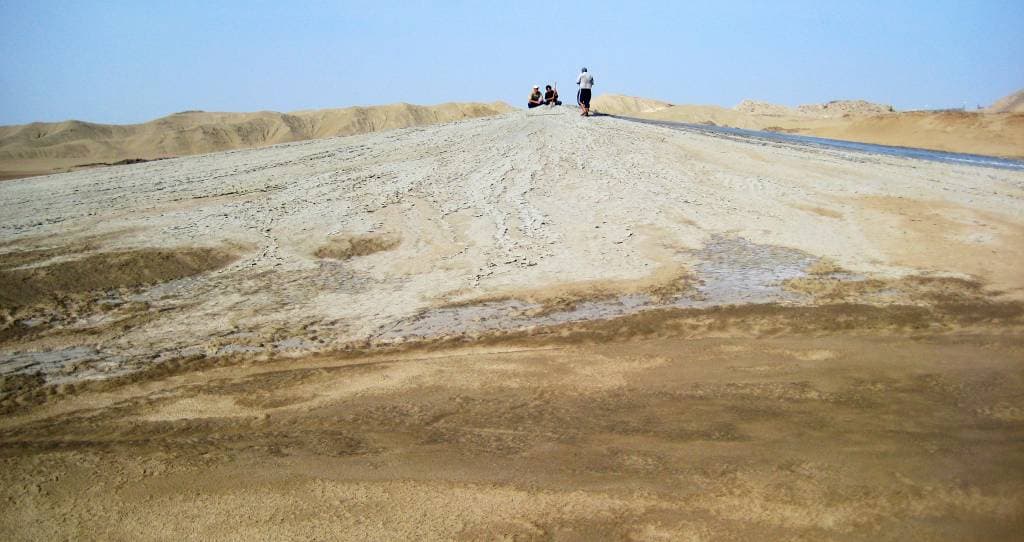
Within the area, running from west to east, are the Western Porsyköl, Pink (Gülgün) Porsyköl and Dagajyk volcanoes. The properties of volcanic products have been studied for many years in the laboratories of hydrogeology, hydrochemistry of oil and gas fields, as well as geochemistry of oil, gas and rocks.
Natural gases of the Pliocene deposits are free gases, as well as gases dissolved in oil and water. Their basis consists of methane, carbon dioxide and nitrogen. The gases are characterized by the absence of sulfur. Water and oil seeps at the Western Porsyköl and Pink (Gülgün) Porsyköl volcanoes occur together with gas. In the Dagajyk section of the Cheleken oil field, oil obtained from depths of up to 1.9 kilometers contains 1.5 percent paraffin. With increasing depth, the paraffin content in the oil increases. The density of oil samples from the Western Porsyköl and Pink (Gülgün) Porsyköl volcanoes ranges between 0.969 and 0.994.
The mineralization level [salinity] of the mud volcanoes averages between 25 and 300 g/l and consists of sodium bicarbonate, sodium sulfate and calcium chloride types. They contain trace elements of iodine, bromine and boron. Samples of volcanic waters are studied on a regular basis.
The waters of the Western Porsyköl mud volcanoes are characterized by a mineralization of 50 g/l and belong to the sodium bicarbonate, sodium sulfate and magnesium chloride type. The water contains up to 1,500 mg/l of sulfates and up to 4,000 mg/l of bicarbonates.
The waters of the Pink (Gülgün) Porsyköl mud volcano are similar in hydrochemical characteristics to the waters of the Western Porsykel volcano; their mineralization equals 25–30 g/l.
In recent years, the formation of gryphon volcanoes has increased within the Çeleken area. These natural phenomena cause complications in the operating conditions of the wells in use. To analyze the impact of a new gryphon formed in 2015 on the conditions of the productive formation, «Galkynyşnebit» oil and gas production department placed an order with a «Nebitgazylmytaslama» institute. To resolve the problem, oil and water samples were taken from the crater of the new volcano and studied under laboratory conditions. It was determined which productive formations the studied samples belonged to, as well as the depth of the volcano’s root. Monitoring work in this direction is being carried out jointly with production specialists. The waters of the Eastern Dagajyk volcano are of the calcium chloride type, with a mineralization of 150–160 g/l.
The roots of the Western Porsyköl and Pink (Gülgün) Porsyköl mud volcanoes are more ancient; they are located in Mesozoic deposits. The hydrochemical characteristics of various calcium chloride-based solutions and the formation of highly mineralized waters are continuously related to the sedimentation conditions of the basin.
Mud volcanoes play a determining role in the formation, preservation and alteration of oil and gas deposits. They remain the primary indicator of the petroleum potential of deposits. The geological structure, petroleum potential and volcanism form a single genetic unity.
Source: «Nebit-gaz» newspaper